I patted the 15-year-old Sachin on the back and said, "You played well". He responded with a half smile.
- I patted the 15-year-old Sachin and said, "You played well". He responded with a half smile.

I sat there munching chips. It was comfortable in the press gallery
at the Gymkhana grounds. I wasn’t a sports reporter but I wanted to be there to
watch a Ranji cricket match between Hyderabad and Bombay on February 3, 1989. I’d
played gully cricket. More for fun (as if if I had been serious, I would have
outclassed many!).
Being there at Gymkhana grounds in Secunderabad was for a purpose. A 15-year
old Bombay school boy was already making waves and he was there playing for the
Bombay team. He had already made a
stunning debut earlier scoring 100 not out in the Mumbai-Gujarat Ranji Trophy
match at the Wankhede stadium (source: Wikipedia). He proved his mettle yet
again with another century later.
I enjoyed my chips. A friend of mine Sunil Robert was one of
the commentators at the match. It was the pre-quarter final between Hyderabad
and Bombay. I, for one, was not interested in who won or who lost in the match.
That was not my cup of tea. I was more keen on observing the techniques and
skills of each of the players. To me, as
an individual, it did not quite matter to me whether they scored big or took a
wicket. The science behind their game was what I was more observant about.
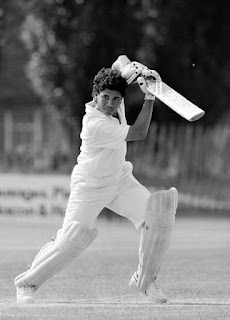
Quite naturally, all eyes were on the little lad from Mumbai who went in to bat for his side. The fact was that everyone was sure that he would make it big and that he was unstoppable going by the cricket he had exhibited so far. A test call could only be a matter of time (And it did come that year when he made his debut against Pakistan in Karachi).
As Sachin went on to bat at the Gymkhana grounds, much was expected
from him. In fact, quite a lot of people there were conscious of the fact that
they were watching one who was already a prodigy and had it in him to dominate
the world of cricket. At least, this is what they wished. At the crease, Sachin
showed prowess. That, however, did not mean more runs were coming off his bat. He
played his game. Showed his skill. Demonstrated his ability so long as he was
at the pitch. He got out. He hadn’t made a big score.
By the time he walked back into the dressing room from the
ground, I quickly got down the make-shift steps of the press gallery where I
was comfortable seated. “You played well,” I told Sachin as I patted him on the
back. It got half a smile as a response. But my appreciation for him was for the way he
played the game – the science and techniques – were what I was appreciative of.
If Sachin was disappointed with his game, he did not show
it. If he was happy at being appreciated and lauded, he did not express it. He went into the dressing room, came back, sat
with the other players and got engrossed in watching the match as it continued.
I went back to the press gallery. My chips were down. Someone
had accidentally brushed against the paper plate and it had fallen. I could ask
for more and get.
But the one who was more hungry was the boy Sachin. In that 1988-89
Ranji season, he exhibited his talent to become Bombay’s highest run getter. He
scored an impressive 583 runs at an average of 67.77 (Again, my source is
Wikipedia).
Sachin went on to make his debut in test cricket playing
against Pakistan in Karachi from November 15-20. He disappointed. He was out
for 15 runs bowled by Waqar Younis in the first innings. He did not get a
chance to bat in the second innings in the match which ended in a draw.
The young and impressive Sachin that I watched at the Gymkhana
grounds in Secunderabad, went on in his career to make and break records in the
international area. He was also bestowed with the nation’s highest honour ‘Bharat
Ratna’.
There were developments in my cricketing career too. At the
Arts College in Osmania University, I had completed my BCJ during the year
1989-90. I went on to join M A (English). I was ‘allowed’ to be captain and ‘accommodated’ in my class cricket
team. We played against another department
at the Osmania University cricket grounds. I scored a zero. I was back to where
I belonged – to the pavilion. My chips were down.


Comments
Post a Comment